

Rarity alone rarely tells the whole pricing story. A fruit can be hard to obtain and still trade for less than expected if nobody’s actively looking for it right now. Learning to calculate demand and rarity together is what separates traders who understand real value from those who just read a single number off a chart. Demand shifts with updates, trends, and how useful a fruit is in current gameplay, while rarity stays mostly fixed once a fruit is released. When you know how these two factors interact instead of looking at them in isolation, you start seeing why some “rare” fruits sit low in value, and why some common ones trade higher than expected.
Why Rarity Alone Doesn’t Decide Value
Understand why rarity alone fails by looking at fruits that are technically rare but barely used in practice. A high rarity classification means little if nobody actually wants that fruit in their build.
Understanding the Demand Factor
The demand factor measures how actively a fruit is being sought after right now. It shifts constantly and often matters more than the fruit’s original rarity tier when it comes to real trading power.
How Popularity Affects Trade Price
A sudden wave of popularity can push a fruit’s price well past its rarity-based baseline. This is where market demand takes over as the dominant force behind the number you actually see in trades.
Balancing Rare Fruits With Low Demand
It’s entirely possible to own something rare that’s hard to trade. Balance rare but low demand items by accepting that scarcity doesn’t guarantee a quick or valuable trade if interest just isn’t there.
Spotting Fruits With Rising Demand
Spot rising demand fruits by watching trade chats and community discussion, not just static lists. A fruit climbing in conversation frequency is often a fruit about to climb in value too.
Why Meta Changes Shift Demand Instantly
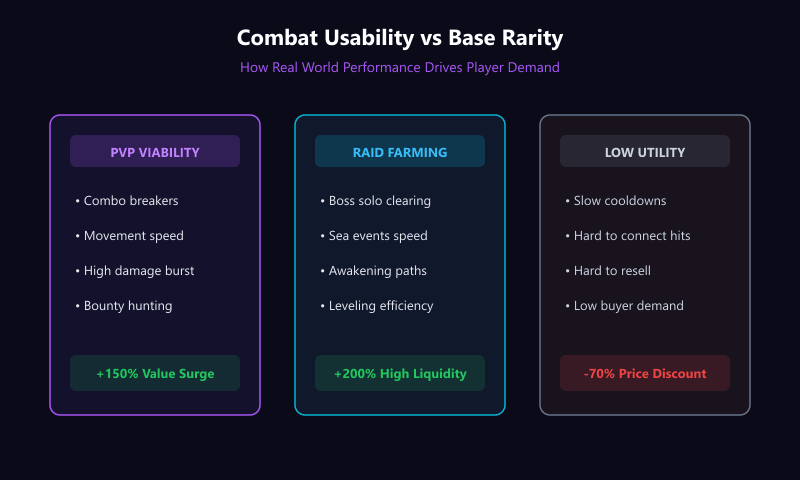
Track demand after meta shifts closely. A single patch that boosts PvP viability or PvE usefulness can send demand skyrocketing for a fruit that was ignored just days earlier.
| Factor | What It Reflects | Impact on Final Value |
|---|---|---|
| Rarity tier | Base classification and scarcity | Sets the starting baseline |
| Demand factor | Current player interest | Can override rarity entirely |
| Combat utility | Real performance in fights | Drives demand up or down |
| Liquidity | How easily it can be re-traded | Affects how fast it moves |
| Meta relevance | Fit with current strategies | Shifts quickly after updates |
Combining Rarity Tiers With Real Usage
Combine rarity tiers with usage rather than judging one in isolation. A mid-rarity fruit with strong combat utility can easily outperform a rarer fruit that nobody actively wants to use.
Reading Demand Indicators on Value Lists
Read demand indicators clearly when browsing a value list. Many sites use a simple demand scale or star rating alongside the base number, which tells you far more than the raw value alone. A fruit sitting at a high value but a low demand rating is often a sign to negotiate harder, since the seller may struggle to find another buyer willing to match that number.
Predicting Future Demand Trends
Predict future value trends by watching for upcoming updates, since developers often hint at changes that shift what’s considered strong weeks before it actually happens in-game. Following official patch previews and community leak discussions gives you a head start over traders who only react once a fruit’s demand has already spiked and the best trading window has closed.
Making Smarter Trades With Both Factors
Smart traders never rely on just one number. Apply both factors to real trades — rarity for the baseline, demand for the real-world context — and you’ll consistently make sharper decisions than someone judging on rarity alone. Over time, this dual approach becomes instinctive, letting you glance at a fruit and immediately sense whether its listed number actually reflects what it’s worth in today’s active trading environment.