

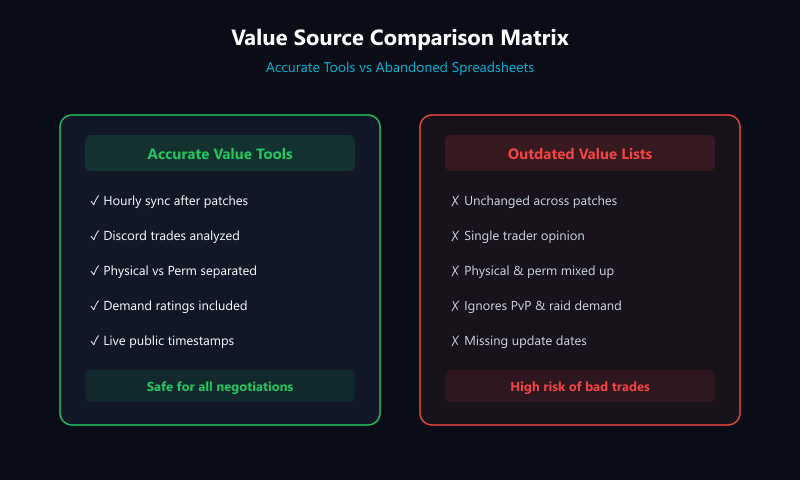
Not every value tool deserves your trust. Some are fast but outdated, while others look official but haven’t been touched in months, still showing prices from patches that ended long ago. A calculator can look polished and still be wrong, which is exactly what makes picking one so tricky. Knowing where to find an accurate calculator matters far more than picking whichever one loads first, because a single outdated number can turn a fair trade into a loss without you even realizing it. The right source keeps its values updated as the game changes, rather than sitting untouched after the first few weeks of hype.
Why Accuracy Matters More Than Convenience
A calculator that’s easy to use but wrong still leads to bad trades. Accurate values come from tools that pull real-time data from actual completed trades, not from a static list someone built once and forgot about. Convenience should never come before correctness.
Trusted Websites for Trade Calculators
Look for a trading hub with a visible value team, clear update logs, and a history of staying active through game patches. A site that shows its last update timestamp openly is usually more reliable than one that hides how old its numbers are.
Community-Built Value Lists Worth Checking
Alongside standalone tools, many traders trust community sourced values built collaboratively by active players. These lists often reflect real trading behavior faster than automated systems, since a trusted community can flag a shift in demand the moment it happens.
Discord Servers With Reliable Value Trackers
Serious traders join a trusted community on Discord, where a value tracker channel posts hourly updates and sometimes emergency updates right after balance changes. These servers double as a live trade feed, letting you watch real offers happen in real time.
YouTube Channels That Track Fruit Values
Some creators specialize in breaking down market data after every update, walking through why certain fruits rose or dropped. Watching a few of these videos helps you understand the reasoning behind a number, not just the number itself.
Comparing Multiple Calculators for Consistency
It’s worth learning to compare multiple calculators side by side. If three separate tools return roughly the same WFL checker result for the same trade, you can move forward with confidence. A single outlier is a signal to dig deeper, not a reason to panic.
| Calculator Feature | What It Offers | Why It Matters |
|---|---|---|
| Update frequency | Hourly or emergency updates | Shows if values reflect current meta |
| Community sourcing | Input from active traders | Reduces single-source bias |
| No account required | Instant, sign-up-free access | Faster, lower-risk checking |
| Verified traders involved | Reviewed listings and feedback | Adds credibility to listed prices |
| Mobile support | Same database as desktop | Keeps checks consistent on the go |
Spotting Outdated or Fake Value Lists
Learning to avoid outdated values starts with checking the update timestamp first. Fake or abandoned lists often reuse old screenshots, miss recent fruits entirely, or claim an unrealistic accuracy rate without any evidence backing the claim.
Mobile-Friendly Trade Calculator Options
Many traders check values on the go, so app-based or mobile-friendly tools matter. The best of these keep the same item database as their desktop version, so you’re never working from a smaller or outdated dataset just because you’re on a phone.
Free vs Paid Trading Tools
Most solid options are a free calculator with no account required, and that’s usually enough for everyday trading. Paid tools sometimes offer deeper trade-ad management or a moderated peer-to-peer marketplace, but they rarely offer more accurate core values than a well-maintained free one.
Bookmarking Your Go-To Value Source
Once you’ve tested a few options, bookmark your value source and stick with it as your primary reference. Revisit it occasionally to confirm it’s still active, still updating, and still respected within the wider trading servers community you trade in.