

Every trading community has its share of bad actors, and Blox Fruits trading is no exception. Scammers rely on speed and confusion, counting on players to accept an offer before they’ve had time to really look at it. Learning to avoid common trade scams early protects hours of grinding from disappearing in a single careless moment, one that can’t be undone once the trade window closes. Most scams follow familiar patterns, whether it’s a last-second item swap, a fake middleman, or pressure to rush the deal. Once you know what these tricks look like, spotting them becomes automatic, and trading starts to feel a lot safer.
Why Scammers Target New Traders
Newer players often don’t yet know the warning signs, which makes them frequent targets. Understanding the basics helps you recognize rushed trade pressure before it turns into an actual loss.
Recognizing Too-Good-To-Be-True Offers
If a deal looks unusually generous, treat it with suspicion rather than excitement. A red flag worth remembering: legitimate traders rarely need to oversell how amazing an offer supposedly is.
Understanding Common Scam Tactics
The switch-out trick is one of the oldest tricks around — swapping an item at the last second before you confirm. Always verify item in trade window right before clicking accept, not just when the trade first opens.
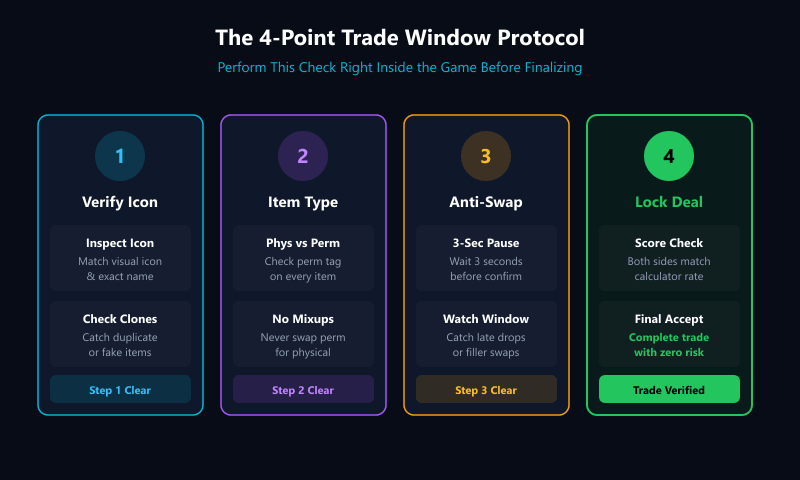
Why Middleman Services Add Safety
For high-value trades, a trusted middleman can hold items and confirm both sides before releasing anything. Just remember to use verified middleman only, since fake middlemen are a scam tactic of their own. For extremely high-value trades, some communities even allow two separate people to confirm the same deal independently, adding a second layer of protection beyond a single trusted middleman.
Verifying a Trader’s Reputation First
Confirm trader reputation first by checking any public trade history or community feedback. A trader with a longer, clean history is far less risky than someone with no visible reputation at all.
Avoiding Rushed or Pressured Trades
Avoid urgency and pressure tactics completely. Scammers often push for speed because it gives you less time to notice something wrong. A genuine trader will never mind you taking an extra minute to check.
| Warning Sign | Safer Response | Why It Helps |
|---|---|---|
| Deal seems too generous | Pause and double-check everything | Scammers rely on excitement |
| Pressure to act fast | Slow down, verify calmly | Removes their timing advantage |
| Request to trade off-platform | Refuse, stay in-game only | Prevents credential theft |
| Unverifiable trader history | Ask for proof or walk away | Reduces risk from unknowns |
| Last-second item swap | Recheck the trade window fully | Catches the switch-out trick |
Screen Recording Trades for Protection
Screen recording trades costs nothing and gives you proof if something goes wrong later. It’s a small habit that turns a “he said, she said” dispute into something you can actually show others. Keep a simple folder organized by date so old recordings are easy to find later, since a dispute can come up days after a trade when the details are no longer fresh in anyone’s memory.
Spotting Fake Trade Calculator Screenshots
Check calculator before accepting using your own tool, not a screenshot someone else sends you. A fake calculator screenshot is easy to edit and should never be trusted as proof of fairness on its own.
Reporting Suspicious Trading Behavior
Report suspicious trading behavior to server moderators or the platform itself as soon as you notice it. This helps protect the next trader, even if you personally avoided the scam this time.
Building Safe Trading Habits Over Time
Build safe trading habits by treating every unfamiliar trader with the same careful process. Consistency, not luck, is what keeps your account and inventory safe trade after trade. Even trusted traders occasionally make honest mistakes, so applying the same checks every single time protects both sides of the deal rather than singling out unfamiliar players as the only risk.